The following rules and regulations are general rules of HuroCup, a robotic game and robotics benchmark problem for humanoid robots. The HuroCup competition emphasizes the development of flexible, robust, and versatile robots that can perform many different tasks in different domains. HuroCup encourages research into the many areas of humanoid robotics, especially walking and balancing, complex motion planning, and human-robot interaction. In addition to the single events (e.g., archery, sprint, marathon, united soccer, penalty kick, obstacle run, rock climbing, spartan race, marathon, weightlifting, and basketball), there is an all-around competition for the single robot that performs best in overall events.
ROBOT SPECIFICATION
DIMENSION | COMMENT | KID SIZE |
$H | Maximum Height | 60cm |
$HM | Minimum Height | 0cm |
$G | Maximum Weight | 20kg |
$D | Maximum foot dimension | 12cm |
$AL | Maximum arm length | Arms must not reach below the knees while standing |
The game is played using humanoid robots. The maximum size of the robots is $H. The maximum weight of the robot is $G
There are one category of robots (kid size) depending on their height and the maximum foot dimension.
The height $H of the robot is defined as the maximum distance between any part of the robot, excluding its arms, and the ground when the robot is fully extended.
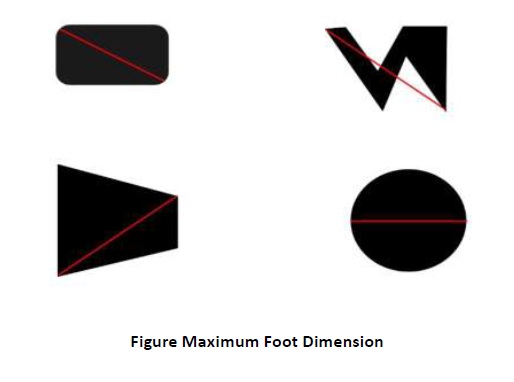
The maximum foot dimension $D is defined as the maximum distance of any two points on any foot of the robot. Some examples are shown in the Figure below :
The length of the arms must be limited such that they cannot reach below the knees when the robot is in a standing posture.
The robot must be limited in its kinematics to actions that are equivalent to human kinematics.
The sensors on the robot must be equivalent to the human senses of sight, sound, touch, hearing, taste, proprioception, balance, and acceleration.
All sensors must be passive, that is they are not allowed to emit signals such as infrared, ultrasound, or laser pulses.
The mode of locomotion of the robot must be bipedal walking or running.
Each robot must have the ability to fully independent locomotion, sensing, and processing. That is, all actuators, motors, power, computing, and sensing mechanisms must be incorporated into the robot.
Each robot must be fully autonomous, that is, it must perform its own control decisions.
Robots may use black and white colouring without restriction. Other colours may be used so long as they are deemed by the rules committee to be sufficiently different from reserved colours, specifically ball yellow, marker red and marker blue.
A robot must not have in its construction anything that is dangerous to itself, another robot, human operators, or spectators.
During the competition, coaches are not allowed to assist participants. Any assistance from a coach will result in the participant's disqualification.
EVENT CATEGORIES
The HuroCup competition includes a variety of events that are categorized into three (3) main groups:
Mobility Events
Mobility Events include sprint and marathon, which test a robot's speed, endurance, and agility.
Manipulation Events
Manipulation Events include archery, basketball and weightlifting, focusing on precision, control, and object handling.
Hybrid Events
Hybrid Events include lift and carry, triple jump and penalty kick challenging robots with complex or hybrid tasks involving strategy, coordination, or multi-skill execution.
SCORING
In HuroCup events, the scoring in an event is based on the performance of the robot as well as its ranking amongst the other robots in a competition.
The score of a robot is between 0 (lowest performance) to 10 points (best performance).
All robots that are unable to meet the minimum performance criteria set for a round will automatically be awarded 0 points.
The robots that have surpassed the minimum performance criteria will be awarded points based on their ranking.
The point allocation is shown in Table Point Allocation.
PLACE | POINTS SCORED |
1st | 10 |
2nd | 8 |
3rd | 6 |
4th | 4 |
5th | 3 |
6th | 2 |
7th | 1 |
8th, 9th, 10th, ... | 0 |
METHOD OF SCORING
Wearable devices and IoT sensors continuously collect patient vital signs, enabling real-time health monitoring and early intervention capabilities. Machine learning algorithms process this data to detect patterns that might indicate developing health issues.
The robot with the maximum number of points over all HuroCup events is declared the winner and the other ranks are determined according to the sum of their scores over all events.
PRIZES AND AWARDS
Overall category awards will be presented for each event categories. A robot’s score in each category will be the sum of its final scores in all events within that category. The robot with the highest total score in each category will receive the first-place award (Gold medal), second place (Silver medal) and third place (Bronze medal) for that category.
In case of multiple robots with the same sum of scores for event categories the tie breaker shall be determined based on the robot’s result/achievements as follows:
Mobility – Marathon
Manipulation - Archery
Hybrid - Lift and Carry
The Master HuroCup champion will be determined by the highest total point for 3 main groups categories. If the tie persists, the final tiebreaker will be determined using the event order under Allround - HuroCup Laws of the Game - [AR-8.4] in FIRA RoboWorld Cup Rules. # [AR-8.4] The order of events is marathon, spartan race, triple jump, archery, obstacle run, basketball, weightlifting, penalty kick, and sprint.